
General
The various business partners represent the external stakeholders involved in the management of WMS processes.
Through the "Business Partners" section, all business partners associated with the warehouse operator can be managed. There is an option to upload a suitable logo for each business partner, which will be printed on documents such as delivery notes or shipping labels during the goods dispatch process.
Business partners can be entered directly through the Web WMS interface or imported via the interface (System Data Interface – Import/Export).
Input options
The entry of basic values for business partners is divided into 4 tabs:
-
General Information
-
Basic details for the business partner
-
-
Accounting
-
Accounting details are maintained here
-
-
Process control
-
Proccess configuration in dependence of the business partner
-
-
Default strategies
-
Default strategies for different proccesses can be set here
-
Additional data can be set in specific tabs that are available with the corresping partner type (for example carrier).

General information
|
Mandatory fields |
Description |
|---|---|
|
Number |
A unique ID must be assigned to the business partner. You can use "##" to generate an ID from COGLAS. |
|
Name 1 |
The name of the business partner must be entered. |
|
Partner types |
One of the assigned partner types must be selected. If none of the selection options apply, a "blank field" can also be selected. |
|
Optional fields |
Description |
|---|---|
|
Ext. no. |
An additional number can be assigned. |
|
Street 1 |
The street of the business partner can be specified. |
|
House no. |
The house number of the business partner can be entered. |
|
Zipcode |
The postcode of the business partner can be entered. |
|
City |
The location of the business partner can be entered. |
|
Country state |
The federal state of the business partner can be specified. |
|
Country |
The country of the business partner can be specified. |
|
Country code |
The country code of the business partner can be specified. |
|
Phone |
The telephone number of the business partner can be entered. |
|
|
The e-mail address of the business partner can be entered. |
|
Name 2 |
A second name of the business partner can be entered. |
|
Name 3 |
A third name of the business partner can be entered. |
|
Street 2 |
A second street of the business partner can be entered. |
|
Company |
Business partner’s company name |
|
Building |
A building number can be entered |
|
Floor |
A floor number/name can be entered |
|
Room |
A room number/name can be entered |
|
Warehouse number |
A warehouse number/name can be entered |
|
Postal number |
A postal number can be entered |
|
Time zone |
The time zone of the business partner can be selected. |
|
Fax |
The fax number of the business partner can be entered. |
|
Reference no. |
A reference number can be assigned. |
|
Reference no. 2 |
An additional reference number can be assigned. |
|
Invoice recipient |
You can select whether the forwarder or the business partner receives the invoice |
|
Deactivated |
The business partner can be deactivated. This selection can be cancelled. |
|
Button |
Description |
|---|---|
|
Enables the entry of a new business partner via the front end. Mandatory fields must be completed and are highlighted when saving if they are not entered (see in red). Save] saves the entry of the business partner data, [Cancel] cancels the process. |

|
With the duplicate function, the selected business partner is used as a copy template for creating additional business partners. The order is duplicated with [Duplicate] and the process is cancelled with [Cancel]. |

|
The data of a called business partner can now be changed. Click [Save] to save the change to the business partner data and [Cancel] to cancel the process. |

|
Existing contacts can be managed here for the business partner, see also below. |
|
For the "Client" partner type, it is possible to transfer all existing stocks via the interface. This can be done manually by triggering the functionality or regularly in consultation with COGLAS. |
Accounting
|
Partner type |
Description |
|---|---|
|
Bill recipient |
Bill recipient for billing and contracting |
|
Carrier |
Carrier for goods in and goods out |
|
Client |
Owner or person authorised to dispose of the stored goods |
|
Customer |
Institution placing the order |
|
External service provider |
External service provider in contract for work |
|
Freight payer |
Freight payer for the order |
|
Loading place |
Place of departure of the goods delivery |
|
Recipient |
Receives the delivery |
|
Sales organization |
Optional additional party |
|
Site |
e.g. additional production site, plant, warehouse |
|
Supplier |
Supplies the warehouse with goods in accordance with the order/request |
|
Unloading place |
Destination of the goods delivery |
|
Accounting |
Description |
|---|---|
|
Tax-No. |
Tax number |
|
VAT no. |
Tax number |
|
Name of the bank |
– |
|
IBAN |
– |
|
BIC |
– |
|
Tax key |
DE / EU / nEU |
|
Financial accounting account no. |
– |
|
Managing Director |
– |
|
Commercial register |
– |
Process control
In the Process Control tab, various “global” process controls can be set for the client (the business partner must also have the entry Partner Type = Client):
|
Process control |
Short info |
Note |
|---|---|---|
|
Report language |
Currently choose between German and English |
|
|
Recipient label report template |
sets a default template for the recipient label |
|
|
Minimum duration until expiration |
Specifies the remaining shelf life for stock with a best before date that can still be reserved for orders. If a value is entered in this field, only stock with a best before date that is greater than or equal to the specified number of days is taken into account. |
Available for partner types unloading place, recipient and client. The remaining validity period is checked in the following order:
|
|
Equipment type |
Here you can specify which types of loading aids the client is allowed to use. |
|
|
Enable Billing & Contract storage fee |
Initializes the B&C storage fee processes. The storage fee data is only available from the time of activation, never retroactively. Please note: If these are deactivated during active operation and reactivated at a later date, the storage fee for this period will be missing. This cannot be reconstructed! |
B/C Storage fees are a premium process and must be ordered separately. |
|
Use goods in date as inbound date for storage fee initialization |
Is required for initialization, but also to store inventory lists that are imported with the correct WE date for warehouse storage fee accounting. |
|
|
Enable stock on reporting date |
Once activated, it is possible to retrieve stock levels retroactively for a specific date from this point onwards. |
The inventory on the reporting date is a premium process and must be ordered separately. |
|
Use goods in date as inbound date for stock on reporting date initialization |
Is required for initialization, but also to store inventory lists that are imported with the correct WE date for warehouse storage fee accounting. |
|
|
Merge quants with different goods in date |
In the warehouse overview, combines identical quants on a storage unit with different delivery dates into one quant. |
A quant is the description for the smallest unit of an item with the same properties that can be addressed within a warehouse. A storage unit with an item that has, for example, two different batches therefore consists of two quants. |
|
Has client exclusive articles |
For exclusive items, the client of the item must match the client of the carrier unit. |
|
|
Remarks confirmation required
|
Controls whether the remarks entered in the order header or in the order position are displayed by default in the process. |
If the checkbox is activated on the client, the recorded notes will be displayed and the process can be continued by clicking Back. If the checkbox is not activated, the notes will not be displayed when the process is called but can be accessed from the mask. 
|
|
Check missing packing level master data to use. |
3 options:
|
Depending on the selection, master data for the packaging units must be entered in delivery note:
|
|
Check missing packing units |
Three possibilities:
|
According to the selection, further steps have to be taken when no packing units in article master data are set. |
|
Delivery remarks |
Carrier-specific delivery remarks |
|
|
Packing remarks |
Carrier-specific packing remarks |
|
|
Loading remarks |
Carrier-specific loading remarks |
|
Contacts
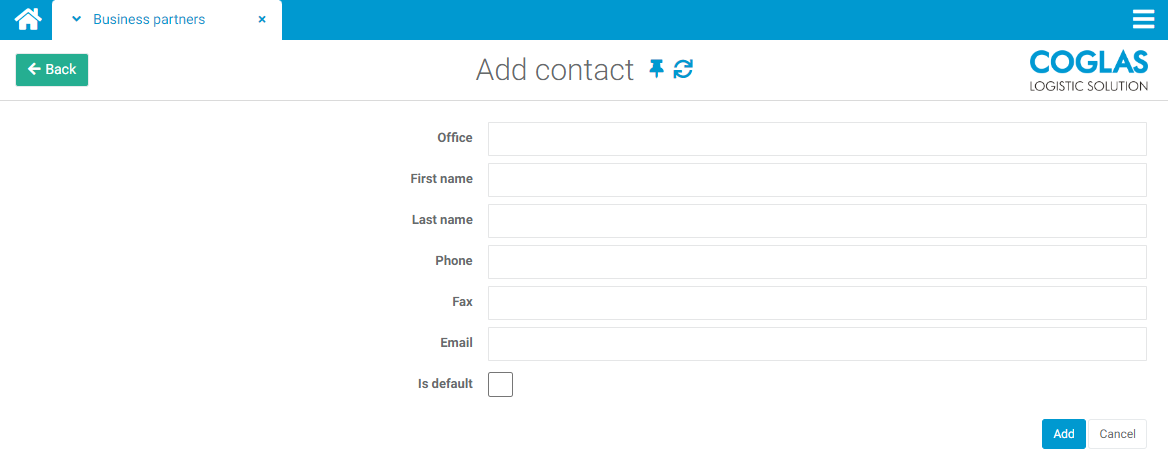
The "Contacts" function allows you to manage contact data. Contacts that have already been created are displayed and can be specified using the search function.
New contacts can be created by clicking on the "Add contact" button. The "Add contact" screen (see Fig. 1: Add contact) opens. The contact details can be saved by clicking the "Add" button. To cancel the process, please use the "Cancel" button. To edit an existing contact, you can use the "Pencil" icon.
Default strategies
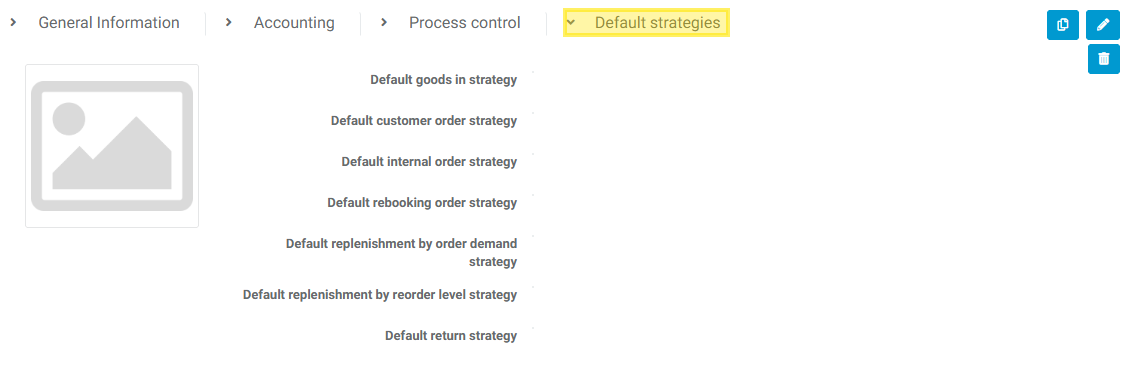
For business partners of type Client default strategies for various proccesses can be set.
Equipment accounts
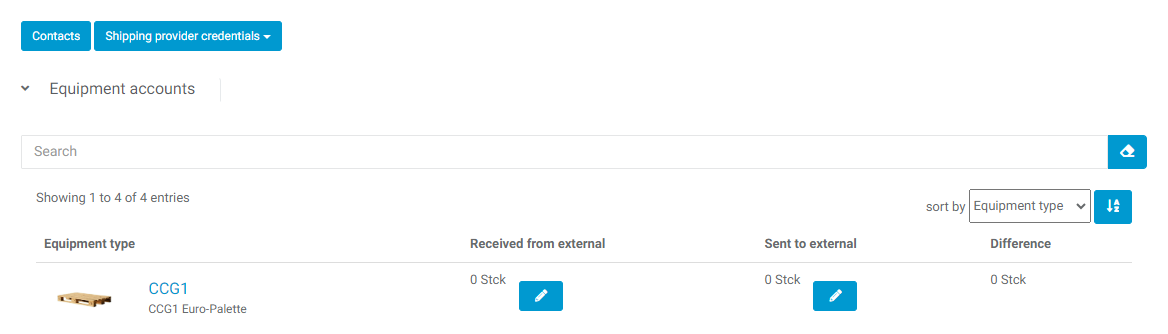
It is possible to log the exchange of loading aids via the so-called equipment accounts. This means that empties can be assigned to accounts outside of merchandise management and settled with various business partners in any cycle.
The recording of receipts and issues can be operated from the processes (goods receipt, transport ' goods issue, goods issue) or recorded directly in an account of the business partner as an adjustment function. However, the account assignment of empties is separate from all merchandise management postings and must be carried out manually.
All transactions are to be understood as posting records that always include two accounts:
-
Empties received or dispatched are booked between the respective business partner and the warehouse operator.
-
Correction postings to the warehouse operator are posted against "Lost & Found".
All postings are logged in the equipment account history.
Carrier
Shipping tariffs and additional services can be created and edited, and then assigned to the forwarding agent (Master data > Business partner > Type: Carrier). A standard tariffcan be stored for each carrier. Assignment via the customer order becomes active in the packing process and is used for transmission to the respective service provider (if a connection to the carrier is established).
Once a carrier has been selected, only the tariffs and information keys assigned to that carrier will be available in the sales order. This data can be transferred via the interface when the order is created.
Process control
As with the client, “global” process controls can be set for the carrier:
|
Process control |
Short info |
Note |
|---|---|---|
|
Report language |
Currently choose between German and English |
|
|
Disable auto packing planning |
Disables automatic packaging planning when starting customer orders. |
Packaging planning can be started manually in the customer order in the Packaging planning tab. |
|
Generate SSCCs and create SSCC labels via shipping provider |
Use of SSCC and SSCC labels from the carrier and not those generated by COGLAS. |
Only for DACHSER |
|
Use picking storage unit for shipping |
Use of the barcode of the picking storage unit in the packaging when the “Process” button is used in the packaging |
Logic for multiple packages: The package with the most items receives the barcode of the KLE. |
|
Multiple storage unit support for shipping |
Printing of all shipping labels during the packaging process |
Only for VCE |
|
Delivery remarks |
Carrier-specific delivery remarks |
|
|
Packing remarks |
Carrier-specific packing remarks |
|
|
Loading remarks |
Carrier-specific loading remarks |
|
Shipping tariff
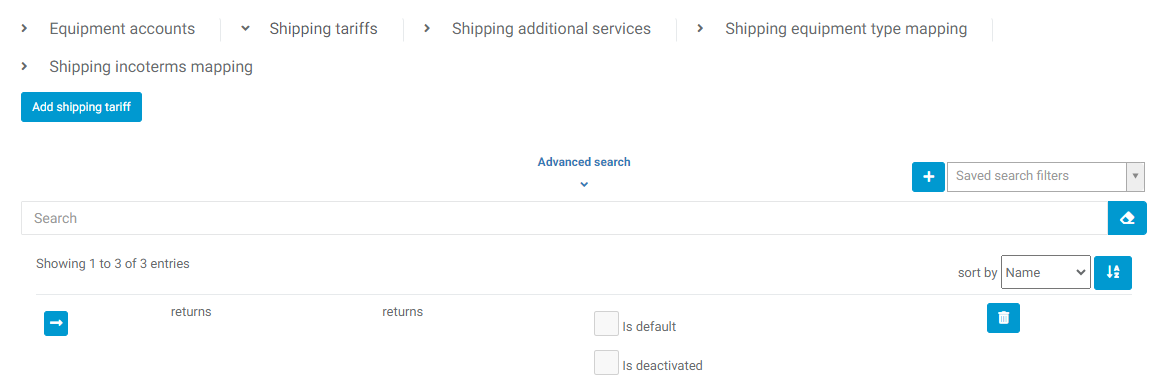
The shipping conditions / rates agreed with the carrier can be stored under Shipping rate. These are then offered in the sales order after the carrier has been selected.
The tariff abbreviation/description, which can also be transferred via the interface, is entered under [Name]. The [Description] is the continuous text information for the respective tariff. This tariff can be selected as the default value via the [Is default] checkbox. Tariffs can be deactivated or deleted.
Additional shipping services
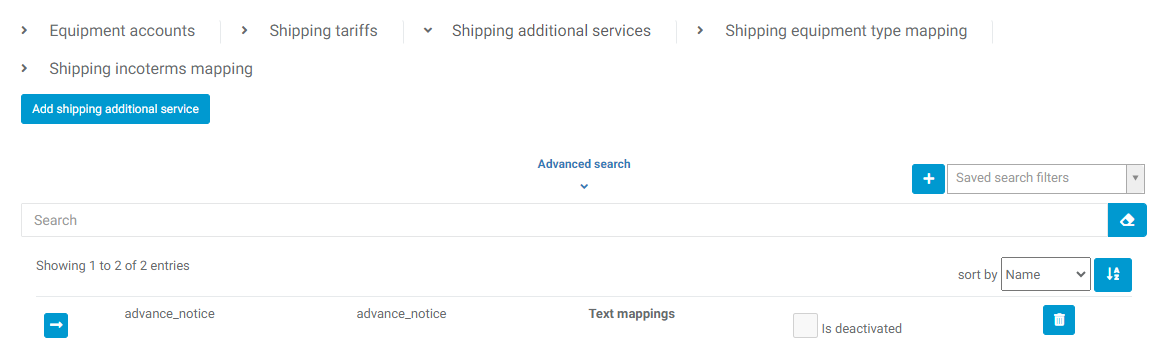
The additional services agreed with the freight forwarder can be stored under additional shipping services.
The additional shipping services that can also be transmitted via the interface are entered under [Name]. The [Description] is the continuous text information for the respective additional shipping services. Tariffs can be deactivated or deleted via .
Additional shipping services are then offered in the customer order after the carrier has been selected. Several additional services can be entered.
Shipping Incoterm selection
The terms of delivery (Incoterms) are predefined values that can be specified for each recipient or unloading location.
At the unloading place / recipient, only one Incoterm can be configured per carrier.
These can also be defined on a per-customer-order basis.
Warning notes
|
Notice |
Description |
|---|---|
|
Validation failed. Please check your entries. |
Not all mandatory fields required to save the data have been entered. |
→ back to COGLAS processes
→ back to COGLAS menu