
General
The dispatch of orders is prepared in packaging. The order to be packed is selected in the list.
The picking containers belonging to this order are now displayed as loading units in the packaging dialogue. They can be accepted directly as a loading unit or split into several containers by clicking the button in the Split column.
After splitting a loading unit, the quantity in the new loading unit can be adjusted using +/-.
As soon as the packing of the goods has been completed, the packing process is finalised via Process. A contents list is printed for each loading unit and the goods are transferred to the staging area. For each loading unit created, the button in the Shipping label column can be used to manually initiate the printing of a shipping label.
As long as the Process button has not yet been pressed, the packaging carried out so far can be deleted by resetting.
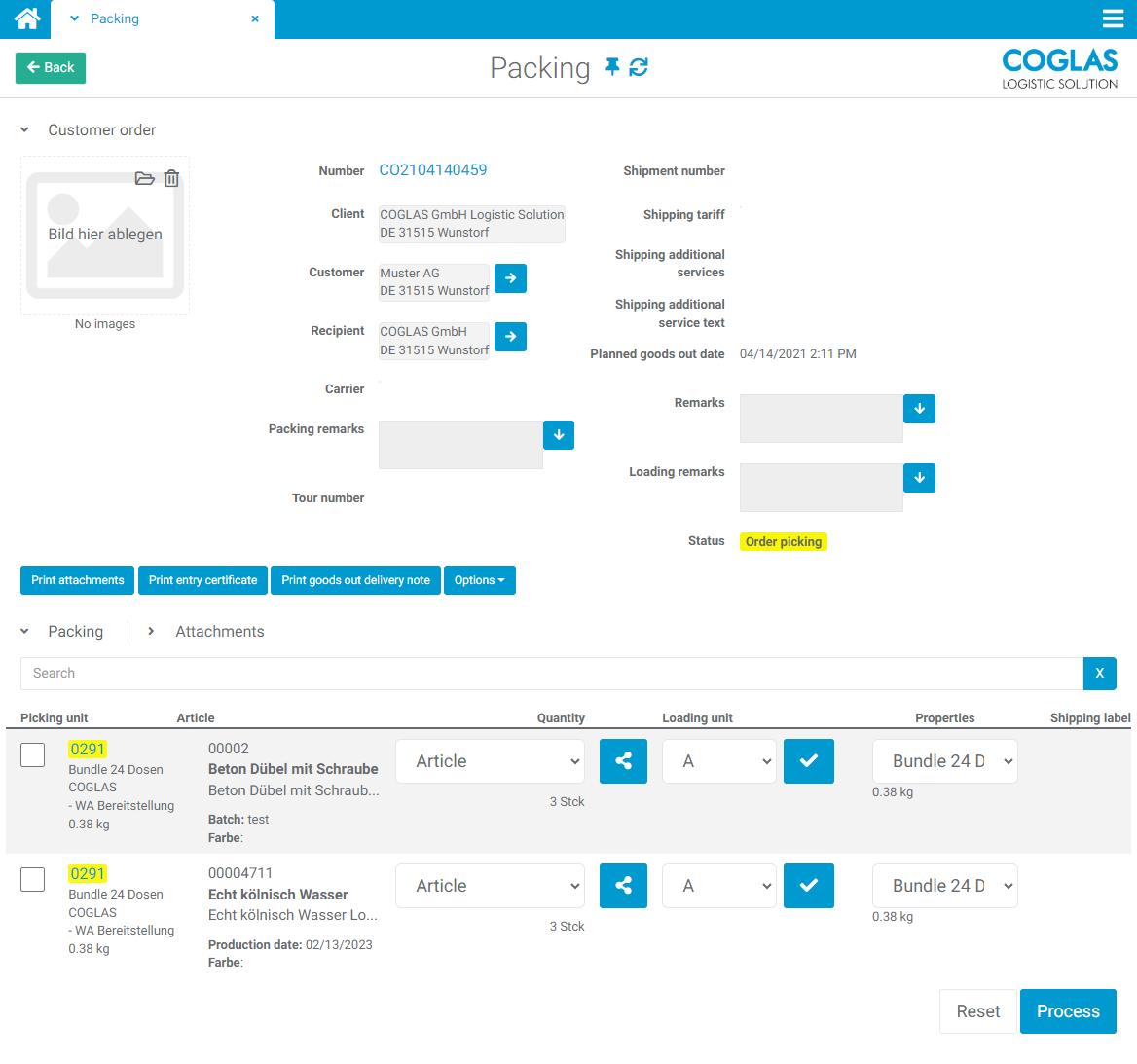
Packing Remarks
Joint packing
Customer orders can be packed together.
This allows different customer orders to be packed in the same packaging unit.
The appropriate orders must be selected in the menue: Packing and opened together using the “Open selected customer orders” button.
Prerequisite for joint packing:
-
The following details on the customer order must match so that the orders can be packed together.
-
Note: The field “Carrier“ is not a mandatory field. If the field is empty, both customer orders must be empty for the “Carrier“.
|
version |
joint packing |
|
|---|---|---|
|
1 |
Up to version 2.115 |
|
|
2 |
From version 2.116 |
|
Packing Remarks
If two or more orders with different packaging instructions are packed at the same time, the following message appears:
Please note that there are different packaging remarks.
-
Only one packaging remark is displayed in the “Packaging remarks” field.
-
Below this is a note stating that there are different remarks.
-
To read the other packaging remarks, the individual orders can be accessed via the link.
-
Entering tracking IDs on the shipping unit
After the packaging process (status ‘Packed’), corrections can still be made by selecting the storage unit. Among other things, a tracking ID can be entered here if it was not previously known or has changed.
To do this, click on the SSCC and then on the pencil icon in the top right-hand corner to edit the information.
Packing process with packing units
In the packing process, a packing unit stored in the article master can be selected in a simplified manner under the ‘Quantity’ item via the drop-down menu. For the loading equipment "Suitable for packaging" must be activated in the master data so that it can be selected.
The system transfers the morphological data maintained in the packaging units even if the quantities do not form a complete packaging unit. This means that the master data of the maintained LHM is still transferred even if the packaging unit has been opened.
Example: The packaging unit in the cardboard loading unit corresponds to 20 pieces; a partially opened carton is picked. In the packaging, COGLAS refers to the dimensions of the stored packaging unit.
Transfer equipment
During the packaging process, packages can be booked onto transfer equipments.
To do this, a corresponding storage unit must be created or scanned in the process using the New transfer quipemnt button. The desired packages can then be booked onto the new carrier unit using the Book loading units to transfer equipment.
Subsequent transports are then carried out via the transfer quipment which carries the individual packages.
Automatic recording of packaging data using connected technology (e.g. scales)
Using the button for automatic data entry, the morphological data can be entered automatically or changed manually in the following menu.

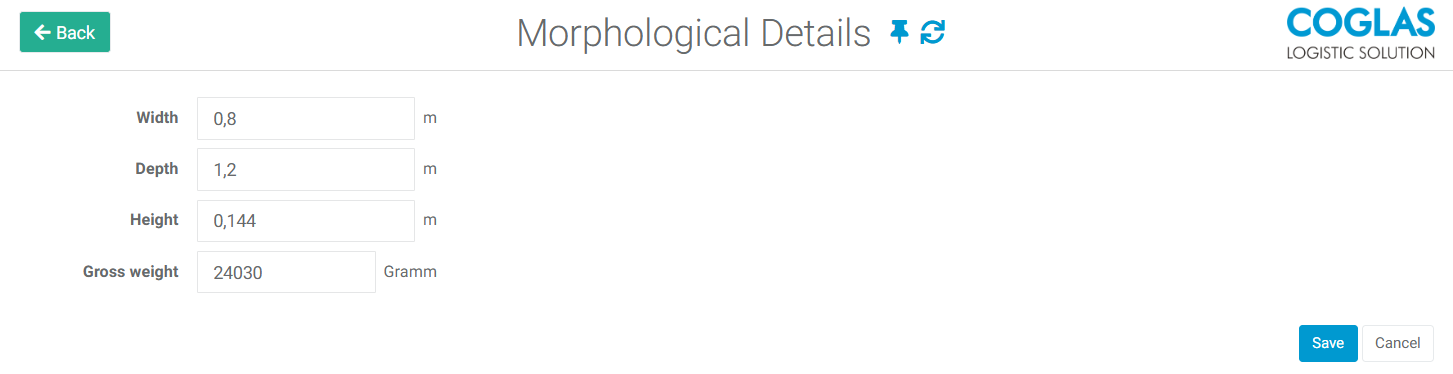
Clicking on the Save button transfers the data to the packaging menu. The packaging must still be completed by clicking on the Process button.
Printing in the packing process
The following elements can be printed during the packing process:

Attachments
If attachments are included with the customer order, these can be printed during the packaging process. The print output can be controlled via the workstation using the document type ‘Attachment’.
Entry certificate
The entry certificate is required for shipments to certain countries, such as Austria. The corresponding report template is called ‘Entry Certificate’ and can be edited there.
Goods out delivery note
The Goods Out Delivery Note can be printed here and in Goods Out Reciept. The corresponding report template is: ‘Goods Out Delivery Note’ (GoodsOutDeliveryNote) or ‘Goods Out Delivery Note (Hazardous Goods)’ (GoodsOutDeliveryNoteHazMat) if the ‘Hazardous Goods’ storage option is activated.
By default, the Goods Out Delivery Note contains the sender and recipient as well as all delivery items in total quantity.
Loading unit content
The packing list can be printed as soon as the first package has been generated. The corresponding report template is called ‘Packing List’ or ‘LoadingUnitContent’ and can be edited there.
By default, the packing list contains information on how many items of each article are contained in the corresponding package. Multiple or individual packing lists can be printed. This is also possible via goods out reciept.
Packing list
The packing list is a document that contains a detailed description of the contents of a shipment, but no information about prices or values. A packing list contains information about the shipment such as size, weight and packaging information.
The corresponding report template is called ‘Packing List’ and can be edited there.
The morphological data of the package is also provided. The carrier LE is also transferred.
The packing list contains information about all items in the customer order and their assignment to the corresponding package.
Automatic printing in the packing process
The following content can also be printed automatically, provided that the corresponding check box is selected in the customer order under Process Control:
-
Auto print delivery note in packing process
-
Auto print entry certificate in packing process
-
Auto print loading unit content in packing process mode (selection of whether printing should take place after each shipping unit or after the last)
-
Auto print shipping label in packing process mode (selection of whether printing should take place after each shipping unit or after the last)
The corresponding fields can be set automatically via the interface.
The fields are:
|
Process |
Name |
|---|---|
|
Auto print delivery note in packing process |
"AutoPrintDeliveryNoteInPackingProcess" nillable="true" type="xs:boolean" |
|
Auto print entry certificate in packing process |
"AutoPrintEntryCertificateInPackingProcess" nillable="true" type="xs:boolean" |
|
Auto print loading unit content in packing process mode |
"AutoPrintLoadingUnitContentInPackingProcessMode" nillable="true" type="xs:string" |
|
Auto print shipping label in packing process mode |
"AutoPrintShippingLabelInPackingProcessMode” nillable="true" type="xs:string" |
Reprinting of single elements
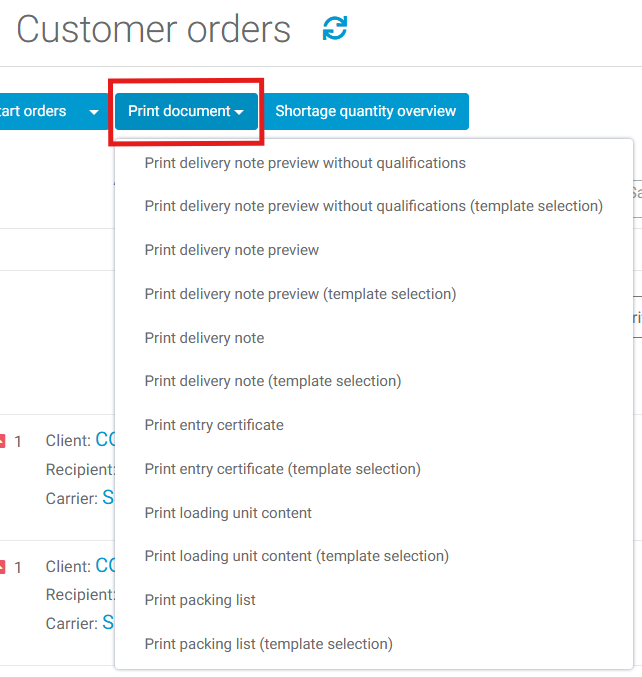
If a print element has not been printed correctly, individual elements can be reprinted via Customer orders - Print document.
→ back to COGLAS processes
→ back to COGLAS menu